Why Keyboard-Only Ring Clerking Protects Your Numbers
The clerk's screen is where every invoice, check and report begins, so attention saved there pays off all the way to settlement.
September 30, 2026 · 4 min read
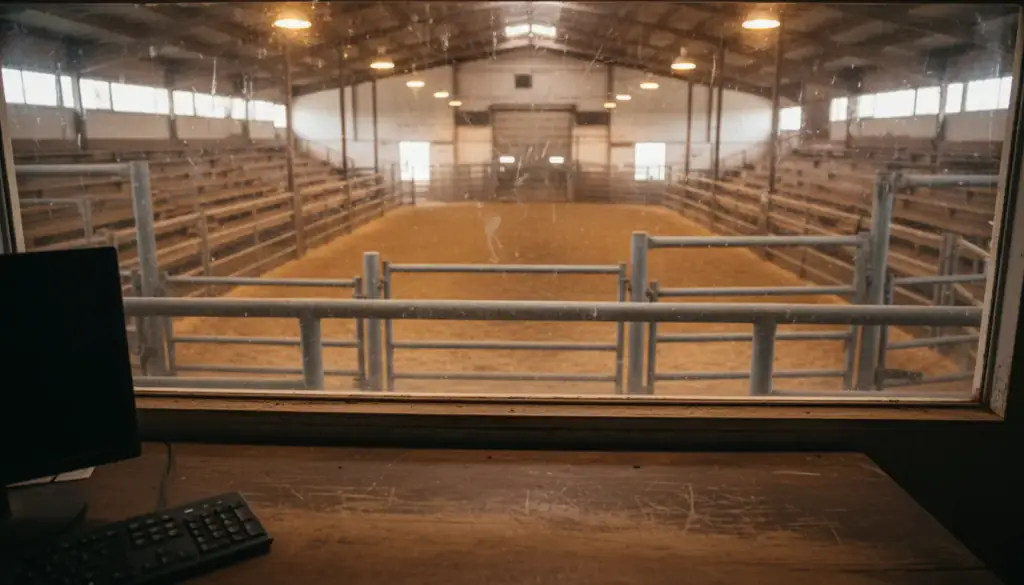
The ring clerk has the hardest job in the building that nobody in the stands ever watches. The auctioneer sells. The clerk turns that sale into a record that has to hold up hours later, when a buyer says he never bought those head or a seller says the weight looks light. Every invoice, every check and every report downstream inherits whatever the clerk typed in the first few seconds after the hammer fell.
What a clerk does between two lots
In the gap between one group and the next, a clerk catches the buyer, confirms the price, checks the head count, takes the weight and closes the ticket. Buyers may bid under a number, a name, or both. Some lots get combined with the one before. Some get split. Now and then a buyer wants a hold placed on his check right there at the block. None of that is hard once. All of it is hard again and again with a full house watching.
That is why the craft of clerking is mostly about protecting attention. Every second a clerk spends hunting for something on the screen is a second not spent listening to the ring. Good clerks develop a rhythm, and anything that interrupts the rhythm costs accuracy before it costs time.
Why reaching for the mouse is a real cost
Watch a clerk who has to move between keyboard and mouse. The eyes drop to the desk, the hand hunts for the pointer, the eyes come back up, and the auctioneer is already two lots ahead. The clerk then guesses at a price or a buyer number to catch up, and a guess at the block becomes a correction at settlement.
U.S. Livestock Systems describes clerking as a fast-paced position where accuracy is key, and says it built the most clerk-friendly system on the market. The part that matters to a barn owner is the concrete part. All the functions can be done with the keyboard only. There is an on-screen help menu for the moment a clerk forgets a key. Weighing is done by pushing one key. Hands stay where they belong and eyes stay on the ring.
Keeping ahead of the auctioneer
A second thing separates a calm clerk booth from a frantic one, and that is whether the clerk can work ahead. While the auctioneer is wrapping up one group, the next group's details are already coming in. The Ring Clerking module has a split screen for this. The clerk keeps entering the next lot while the auctioneer finishes the previous group, so nothing has to wait for the ring to go quiet.
It changes the feel of the room, too. A clerk who is caught up can look at the ring, notice a buyer number that does not match the face holding the card, and ask. A clerk who is behind can only type.
Fixing mistakes without losing the thread
Every clerk makes mistakes, and pretending otherwise only hides them. What matters is how cheaply one can be fixed. In the U.S. Livestock Systems program a clerk can edit the last ticket, or any earlier ticket that was saved. An animal or group from a previous transaction can be resold or re-run. Several drafts can be combined, and animals can be split off a draft quickly. A hold can be put on a check from the block.
Consider the alternative. A wrong weight caught ten lots later, on a system that only lets you touch the current ticket, turns into a note on a scrap of paper that somebody in the office has to reconcile after the sale. Notes on scraps are where books go wrong.
When a buyer questions a lot
Disputes are part of the business. A buyer remembers a different price or a seller questions a count, and the clerk's memory is not evidence. Video Capture records audio and video for Ring Clerking. In the scale tickets, a right-click plays the clip of that individual transaction, any time, from any computer running the office program. The videos are stored automatically with a delete date that the barn sets.
U.S. Livestock Systems says this saves time and money and keeps customers happy. The practical version is simpler. A disagreement that used to take a phone call, a long memory and a split-the-difference settlement can be settled by watching the clip.
Whatever system you run, these are fair questions to put to any clerk screen before you commit to it.
- Can every function be done from the keyboard, including weighing?
- Can the clerk keep entering the next lot while the auctioneer finishes this one?
- Can you edit any saved ticket, not only the last one?
- Can you resell, combine or split groups without re-entering them?
- Can you pull up the record of one transaction later in a few clicks?
If you want to see how those questions get answered on a working clerk screen, call U.S. Livestock Systems at (573) 682-1080 for the password to their demo videos.
U.S. Livestock Systems, Inc., (573) 682-1080
Call (573) 682-1080More articles
Where the Hours Go on Sale Day
The ring moves as fast as the cattle do, so the hours that push a sale past dark are almost always somewhere else in the building.
Closing Up After the Sale Without Losing Your Night
Closing the books on a sale day is a routine, and the barns that finish early treat it like one.